
- Mitranshu Gamit
In Vyara, a town in the tribal-dominated district of Tapi in South Gujarat, a unique struggle is being fought today. The proposal to hand over the Vyara District Hospital to private hands to run a medical college has shaken the people of the district. Their opposition is not just to a single decision, but is a protest against a policy based on profit rather than public health. It is driven by the belief that everyone should have the right to affordable and good treatment. This struggle is not just about one hospital—it raises a deeper question: who is our health system really for? The people, or private corporations?
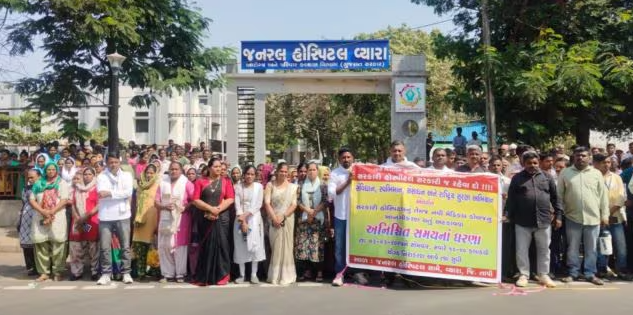
Tapi’s Lifeline: Not just a hospital, a lifesaver
Vyara Hospital is not just a building with three hundred beds. It is the nodal hospital for the people of Vyara, as well as the entire Tapi district. People from many villages in nearby tribal-dominated districts like Dang and Nandurbar (Maharashtra) also depend on this hospital for major operations or referrals. This is why its public role is so crucial.
The Gujarat government has proposed that the hospital’s care and management will now be handed over to a private trust linked to the pharmaceutical company Torrent. The private trust will build and run a medical college, which could lead to government land and assets being used for private education and profit-making. This change sems like a bad deal for the public: free treatment could be cut down, fees could increase, and the hospital for the poor and tribal communities could become inaccessible.
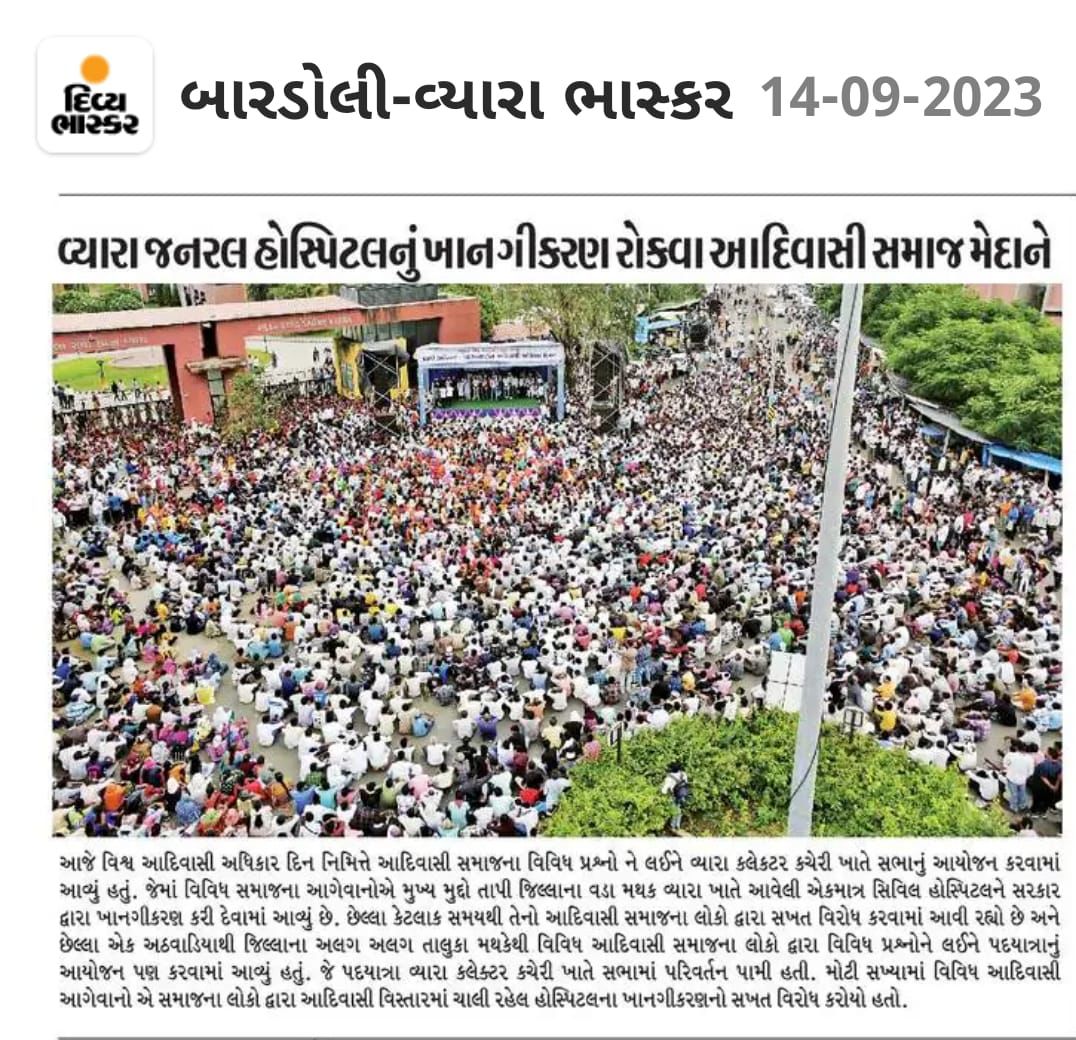
Adivasi people raise their voice
The government claims that privatisation will improve the hospital’s condition and bring in specialist doctors. But Vyara’s people feel that this “cure” might turn out worse than the disease. What began as small gatherings soon grew into large protests as people started raising their voice continuously.
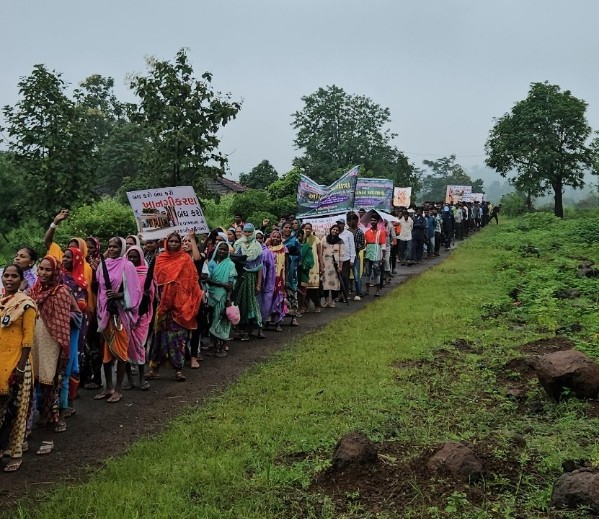
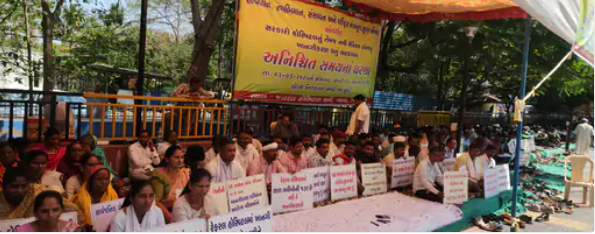
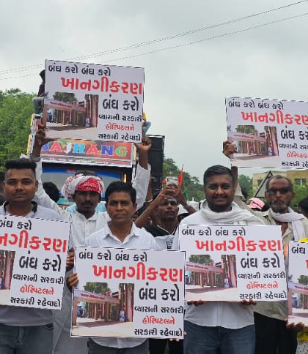
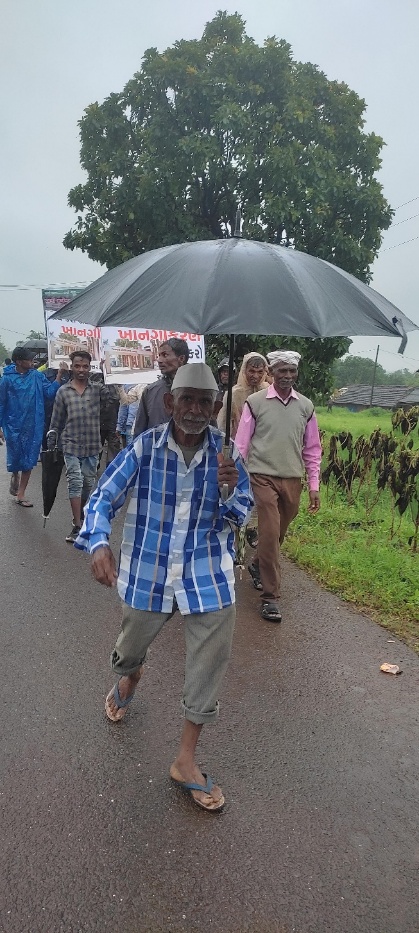
A Yatra for public mobilisation – In September 2023, an awareness yatra travelled through village after village across the Tapi district. The march reached out to around 150 villages, mobilising people to join the struggle, and support grew rapidly. Soon, the streets of Vyara saw sit-ins outside the district headquarters, rallies with banners saying “Our Hospital in Our Hands”, and memoranda being handed to officials. Media coverage, YouTube videos and social media discussions have carried the Vyara struggle beyond the district, across Gujarat.
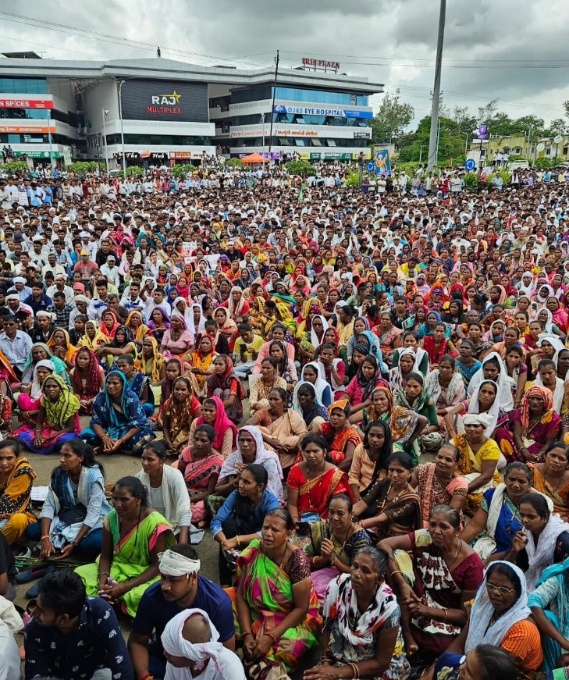
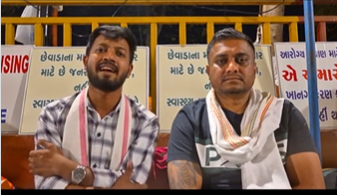
60-Day Sit-in and Fast – Starting in early March 2025, the tribal community launched a major movement against handing over Vyara Civil Hospital to private entities. Tribal activists and community members began an indefinite sit-in within the hospital premises, people started continuous hunger strikes, and demanded a written assurance that the hospital would not be handed over to any company. This widespread movement continued until the beginning of May 2025. Local newspapers consistently covered these protests. Through sit-ins, rallies, and submitting memorandums to the Collector, the tribal community has demonstrated its strength. People from different villages and talukas of Tapi district gathered in large numbers in Vyara, raised slogans, and sent out one clear message: Save Our Public Hospital.
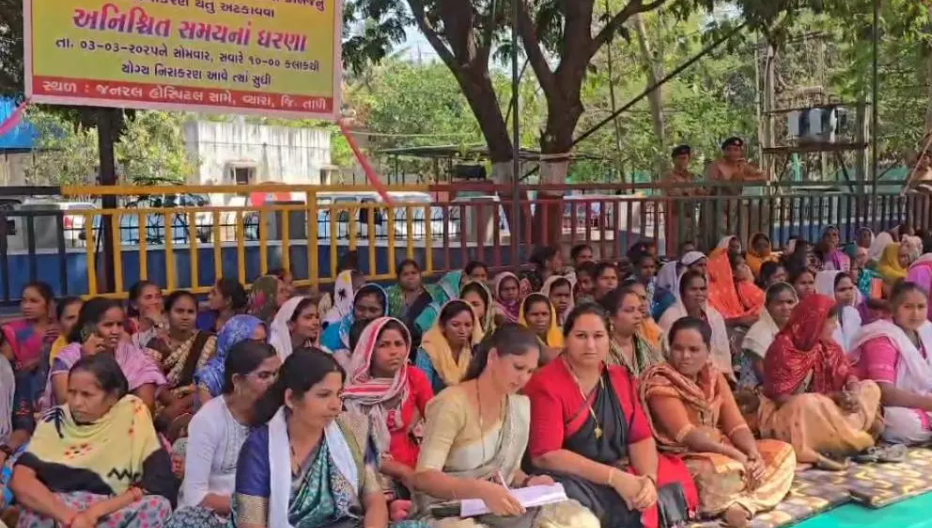
The movement has been coordinated by the Samvidhan Swabhiman Sansadhan aur Rashtra Samprabhuta Suraksha Abhiyan Samiti—a committee that has now become the voice of the people.
The core issue of the struggle: Healthcare as Right or Business?
The government and officials have promoted this public-private partnership (PPP) as necessary, claiming that services will improve, and it will not put a heavy burden on government funds. But the people of Vyara do not seem to trust these promises. Their skepticism, based on their own experiences and those from other places, is linked with these concerns:
- Will care be charged for, becoming unaffordable? A major reason for opposing the privatization of Vyara Hospital is that the government plans to convert it into a Self-financed Medical College (GMERS). This means patients might have to pay higher fees for services at this teaching hospital, and the hospital’s operations could be run in commercial manner for training medical students. People are worried this change will lead to the commercialization of healthcare services. Their biggest fear is that treatment will become more expensive. Will life-saving medicines and tests become costly? For poor families, even a small fee can be a reason to avoid seeking treatment.
- Who will be accountable? A government hospital is accountable to the public, while a private company’s goal is to make money. People are asking, “Will this company work for our health, or for its profits?” They fear that attention will be given only to patients who can pay more, while the general public will be neglected.
- The future of healthcare employees: What will happen to the doctors, nurses, sanitation staff, and other employees who have worked here for many years? Will they lose their jobs? Will they be forced to work for lower wages?
- Problematic experiences with earlier PPP models in Gujarat – Furthermore, experiences with other PPP hospital deals in Gujarat have increased people’s anxiety. Vyara Hospital is considered one of three major recent PPP efforts in Gujarat involving large private groups. Key hospital PPP cases in Gujarat have involved different large private groups, such as the deals in Bhuj (Adani Group) and Dahod (Zydus Group). Looking at these past experiences, locals worry that the character of Vyara Hospital could change, and public access could become limited. In case of other hospitals handed over to large private companies, there have often been complaints of increased treatment costs, higher fees, and management irregularities. Supporters of the movement see these instances as warnings, and want Vyara Hospital to remain fully government-run and accessible to the people without barriers.
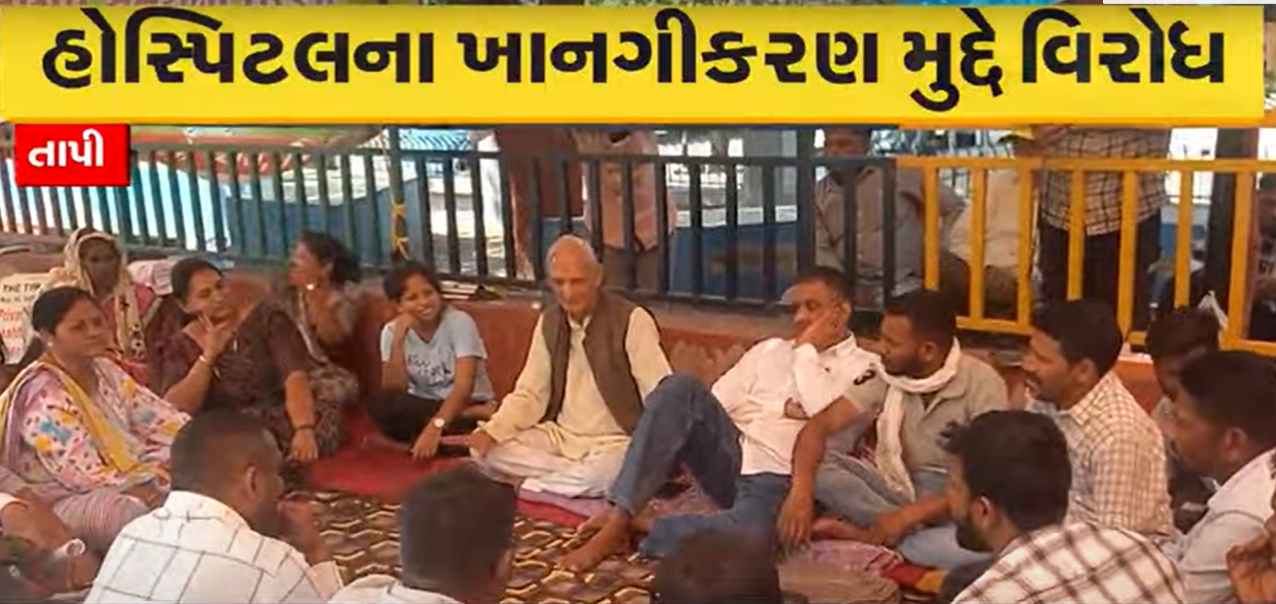
The people of Vyara are not against development or improved facilities. But they are demanding that the government system itself should be strengthened—appoint more doctors, improve hospital infrastructure and management—rather than the government shifting its responsibility onto private companies. Their struggle is an important reminder that a public hospital should not be treated like a business to earn profits. A public health institution is a social necessity, a place of refuge, and its services should be regarded as a basic human right.
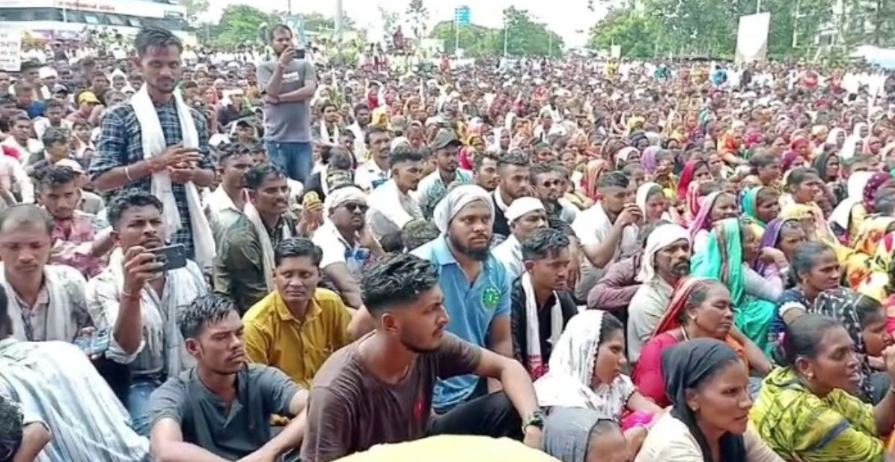
Notable aspects of the Vyara movement
This movement has adopted several noteworthy strategies:
- Continuous Sit-ins and Hunger strike: When people learned that decisions were being made without public consultation, they started coming from villages to the hospital gates every day to raise their voices. The continuous 60-day sit-in and hunger strike from March to May 2025 shows that when the issue is serious, people do not back down or stop despite all challenges.
- Significant participation of women: Women have been particularly active in these protests. Experiences related to childbirth, caring for the sick, and child health needs are extremely sensitive for women and families; keeping this in mind, everyone’s access to the hospital must be maintained.
- Unity of adivasi communities: The unity of the adivasi community and their connection to the government hospital is the soul of this movement. The fear of higher costs, the potential neglect of tribal people from remote villages, and the apprehension of private management—these powerful concerns suggest that such a change would be against public interest.
- National support: NAPM (National Alliance of People’s Movements), public health activists, human rights groups, and health experts—all have sent appeals and have written open letters. This support elevated the movement from a local issue to a matter of broader concern.
The resistance by people of Vyara has drawn the attention of many social organizations. Veterans like Medha Patkar of the Narmada Bachao Andolan have supported this struggle. The issue was also raised in the Gujarat Legislative Assembly, forcing the government to acknowledge public anger. Public pressure has slowed down the privatisation plan—for now, the handover has not gone forward.
Recently, in July, Vyara activists met with the Chief Minister of Gujarat. Reports from this meeting indicate a response from the CM’s side on these lines: “People across Gujarat have no problem with privatization, so why are you protesting? Do whatever you want, this deal will not stop.”
In this situation, the people’s committee is now monitoring further developments. The struggle has reached a turning point. The people have shown they will not give up, and the government has received the message that any renewed attempt at privatization will face strong public opposition.
Has Gujarat government embraced privatization as a policy?
The Vyara struggle is part of a much wider policy trend: the PPP model of handing over public health facilities to private and corporate bodies. In recent years, several hospitals and health institutions in Gujarat have been targeted for such handovers. The logic: reduce state responsibility and let private capital profit. But this policy has serious negative implications. Firstly, healthcare, which must be treated as a human right, turns into a market commodity driven by money and profit. Secondly when free care is restricted, poor and Adivasi people suffer the most. Thirdly, private management often lacks transparency. Staff salaries and conditions worsen. Priorities shift away from serving patients towards earning higher profits.
The struggle should now reach its logical conclusion – in favour of people
In tribal areas like Tapi, Dang, Narmada, and surrounding districts, healthcare, education, and livelihoods are already in crisis. Malnutrition, disease, and problems accessing remote hospitals—all these are major challenges for people. In this situation, the people of Vyara are not just fighting to protect their own needs; they are raising fundamental questions about the government’s policy of privatizing health services. Now, this struggle must conclude in favour of the people. The following steps are essential:
- Government health services must remain in public hands: The privatization plan should be permanently withdrawn.
- Any decision related to health services must involve public consultation, especially the consent of tribal communities and the implementation of legal protections under the Fifth Schedule.
- Public hospitals must be strengthened—increase doctors and staff, improve equipment, ensure free and adequate medicines, and maintain free treatment facilities.
- Social movements, media, and health activists must continue working on this issue to ensure the government remains publicly accountable.
Vyara’s voice, concern for the entire nation
The struggle to save Vyara Hospital from privatization is gaining momentum again as the government recently tried to hand over parts of the hospital to a private agency. The leaders of this movement have appealed for national solidarity and support for this movement, since it is a serious issue linked with policies that affect people across the country.
The aggressive policy of privatizing health and social services in India has been most visible in Gujarat so far. In such a scenario, a victory for Vyara’s anti-privatization struggle would be a decisive step for health movements across India, demonstrating that privatization can be defeated by people’s power.
The time has come for all of us to actively support the fight to save Vyara hospital.
(The article has been edited by Abhay Shukla)

Great fight. I do not understand why govt. Needs so many teaching hospitals/ medical college when teachers are not available and students do not attend hospital to learn as there are hardly any patients to examine, a vicious cycle that is going on for a XL long time. Society needs good knowledgeable doctors.