
How Vijayapura’s people defended their medical college

In the historic city of Vijayapura in Karnataka, home to the architectural marvel of the Gol Gumbaz, a different kind of marvel recently emerged—a monument to collective resilience. For 115 days, the B.R. Ambedkar Circle in Vijayapura city, the headquarters of the eponymous district (formerly known as Bijapur) became the beating heart of a movement that would eventually compel a powerful state government to retreat from its plans to privatize healthcare. This is the story of how a diverse coalition of ordinary people including urban communities, women, students, farmers, medical professionals and diverse activists defeated the Public-Private Partnership (PPP) model and forced the State government to commit to building a public medical college in their district.
The initiating spark: A Minister’s controversial announcement
The seeds of the struggle were sown in July 2025 during a session of the Karnataka Legislative Assembly. Vijayapura MLA Basanagouda Patil Yatnal raised a pertinent question: when would the state government fulfill its long-standing promise of a government medical college for the district? The response from Medical Education Minister Saran Prakash Patil sent shockwaves through the region. He declared that Vijayapura was not under the “government medical college quota” but was instead slated for the “PPP quota.” He offered a ‘carrot’ of ₹500 crores in investment, provided the institution was developed based on the PPP model.
The response from people in Vijayapura on the ground was instantaneous. “Immediately, around 25 to 30 people from different organizations met and decided to form a committee to fight against the PPP model, to ensure a government medical college,” participants recalled. This committee was named the Sarkara Medical College Sthapana Horata Samiti (Government Medical College Establishment Action Committee). For the people of Vijayapura, the proposal felt like a betrayal, especially when neighbouring Bagalkote, which was once part of Vijayapura, had already been sanctioned ₹500 crores for a government medical college.
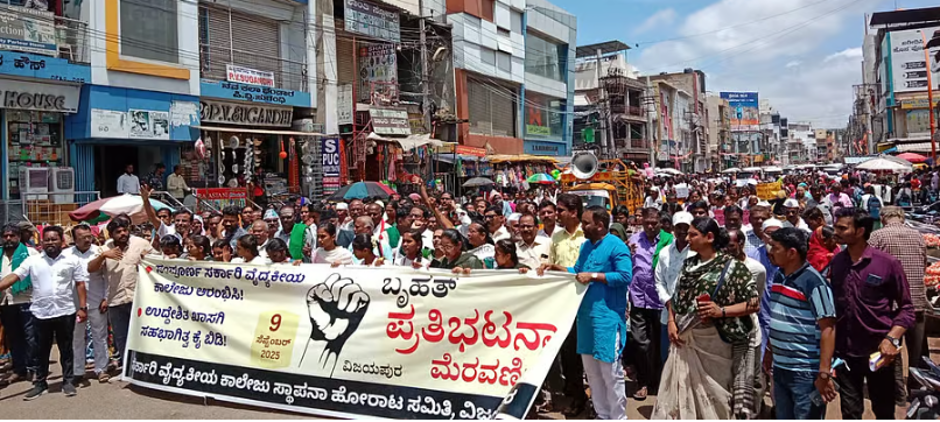
Building a struggle from the grassroots: 153 acres of evidence
The struggle began with activist delegations meeting the Vijayapura District In-charge Minister M.B. Patil and Agricultural Marketing Minister Sivananda Patil (also from Vijayapura district) and appealing for a government medical college in Vijayapura. The activists also travelled to Kalburgi (formerly Gulbarga) to petition the Medical Education Minister at his residence. When the Chief Minister and Deputy Chief Minister visited the Almatti Dam for an event, the Vijayapura people’s committee was there, memorandum in hand. The response from Ministers was just a bureaucratic “We will see.”
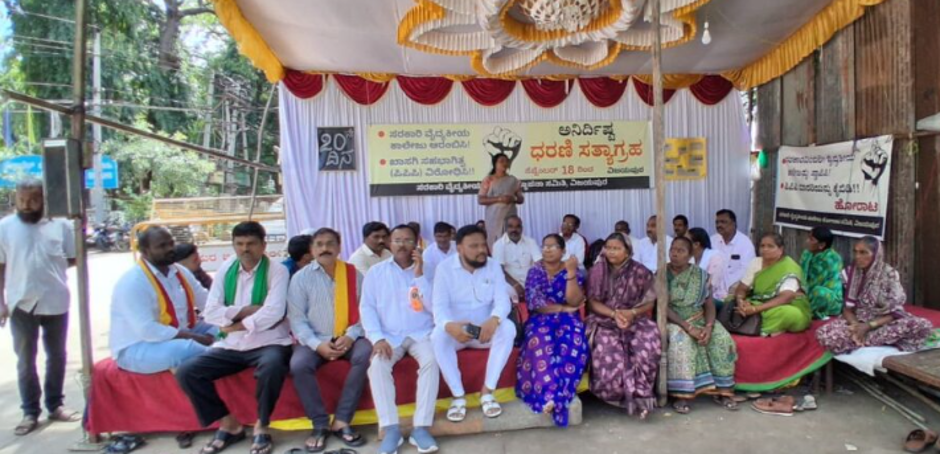
As the government moved ahead by appointing an officer to initiate the PPP tendering process, the people’s committee realized that memorandums were not enough. On September 18, 2025, amidst heavy monsoon rains in Vijayapura, an indefinite Dharna began at B.R. Ambedkar Circle. The committee’s strategy was rooted in hard data. They sought contributions and printed 50,000 leaflets, – distributing these to debunk the government’s claim that there was a lack of public resources. “We highlighted that 153 acres of government land are already available. The government need not purchase even a single inch,” the activists noted. The infrastructure was already there: a 700-bed hospital, a Mother and Child Hospital (MCH), and a trauma centre. With 131 acres of vacant land ready for expansion, the argument for privatization on the grounds of “lack of infrastructure” was exposed as a hollow excuse.
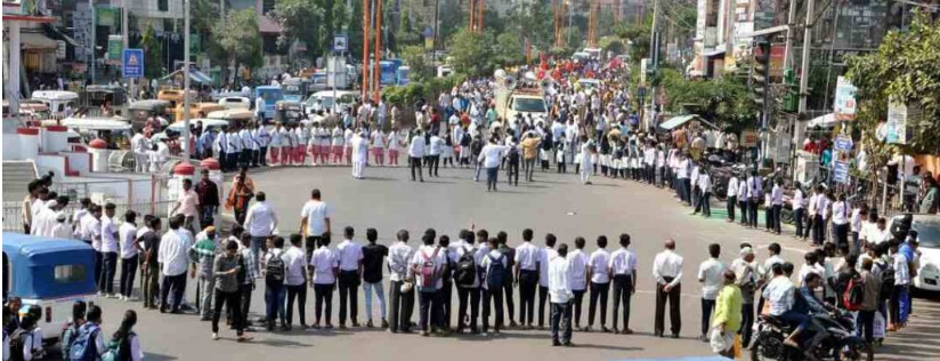
Paksha Teeta, Dharma Teeta, Jati Teeta: People’s solidarity cutting across boundaries
What makes the Vijayapura struggle unique was its broad based inclusivity. The movement adopted the motto Paksha Teeta, Dharma Teeta, Jati Teeta—meaning beyond party, beyond religion, and beyond caste. “Anyone who supports a government medical college can participate. But they should not raise their sectoral demands there,” was the minimum common agreement. This allowed a rare sight in modern Indian politics: the INC, JDS, AAP, CPI, CPM, SUCI, women’s organisations and even some persons belonging to Hindutva organisations standing alongside Dalit, Muslim, Sikh, and Banjara organizations.
The movement had to bridge a massive public awareness gap. In rural taluks, many did not understand the acronym ‘PPP.’ The committee simplified it into the local language: “PPP means privatization. A private medical college would be built on our 153 acres of land, and our district hospital would effectively go into private hands.” They warned the public that assets worth over ₹500 crores were being handed over to private interests—including even their local MLA who had expressed interest in investing in the PPP model.
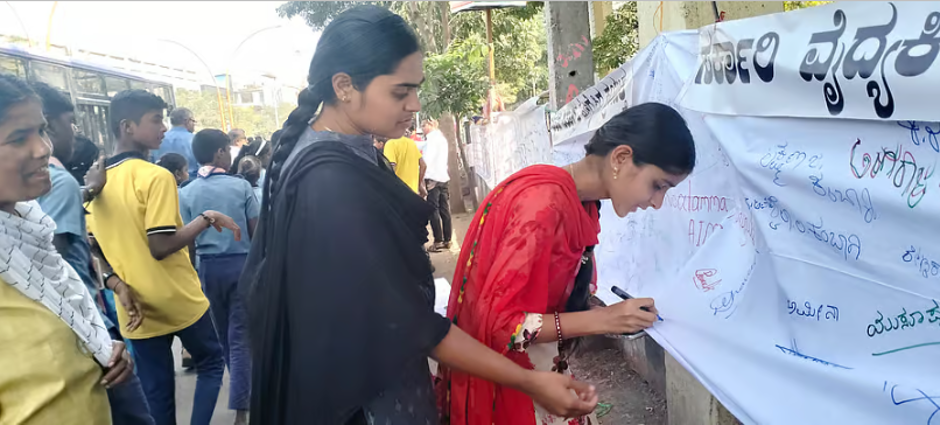
The student surge: From classrooms to the streets
The turning point of the 3-month long protest was the massive student rally on December 1, 2025. Recognizing that students in Pre-University Colleges (PUC) would be the most affected by the loss of affordable medical seats, a separate college campaign committee was formed. “In almost every college, 99% of students did not know about the protest,” the organizers revealed. They reached out to 35 colleges, explaining how privatization would shut the doors of medical education for the poor and middle class. They invoked the legacy of Bhagat Singh, telling students: “We are not asking you to sacrifice like him; we are just seeking your 2-hour participation in a rally.”
The result was a tidal wave. Over 4,500 students—including nursing, paramedical, and BAMS students endorsed the movement with many taking to the streets. This youthful upsurge surprised the media and the administration alike.
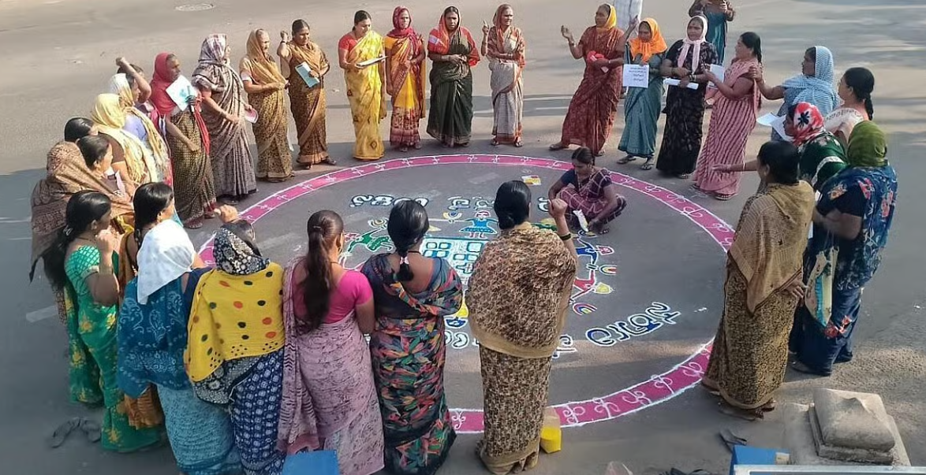
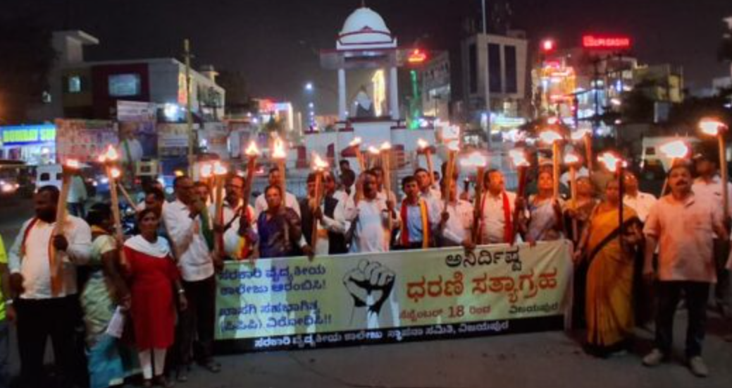
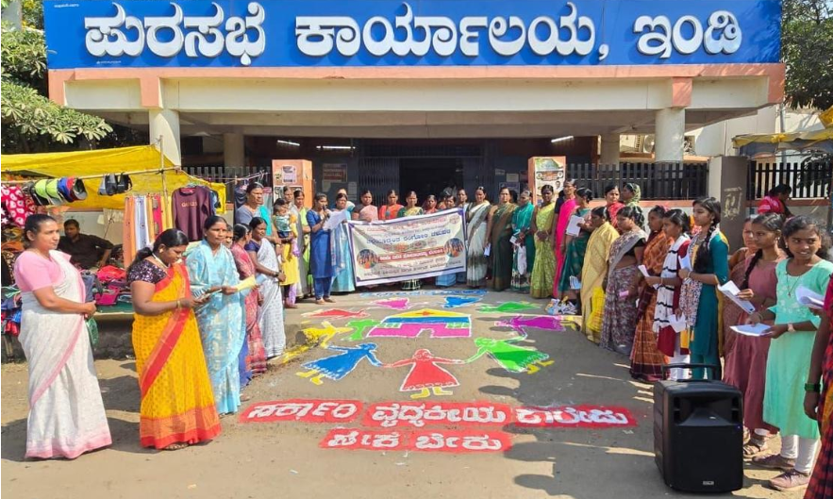
The protest also took on a cultural dimension: women organized Rangoli (street art) events across 30 locations, while artists joined for music nights, poetry writing, and torchlight processions. Even the Indian Medical Association (IMA) lent its support, contributing ₹25,000 to the cause. The entire movement was funded by such public donations.
Intensified repression and fourteen days in “Dargah Jail”
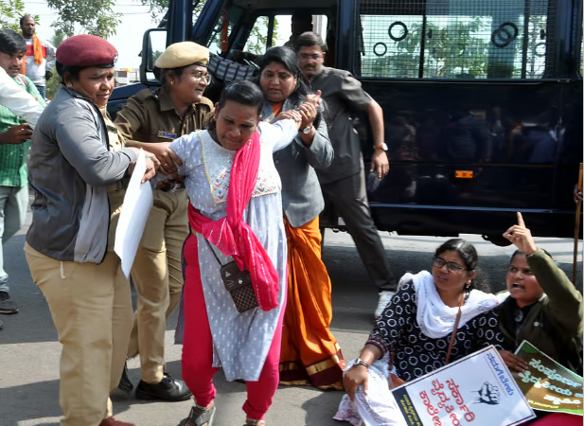
As the movement gained steam, the state government’s response hardened. On January 1, 2026, protesters decided to peacefully protest outside the local minister’s house. The police refused permission and, in the ensuing tension, physical altercations occurred. A local Swamiji’s phone was snatched, and women were pushed in the melee. Twenty-seven protesters were arrested. They were kept in police vans for hours before being sent to the Dargah Jail in Vijayapura. They spent 14 days behind bars, entering on New Year’s Day and finally being released on Makar Sankranti.
The state attempted to delegitimize the movement by filing FIRs under eight different sections, including a shocking and blatantly false charge of “attempt to murder”. Protesters alleged that the arrests were politically motivated, with photos of the crowd sent to ministers who “identified who to jail.” However, the jail time only served to boost the movement’s morale. “Jail inmates and police personnel appreciated us,” the activists recalled. The leading activists were inside the jail library, when they received the first news of their victory.
Victory and more miles to go
While the protesters were in jail, the political ground shifted. In the Assembly, MLAs from both the ruling and opposition benches began questioning the government’s pro-privatisation stance. On January 6, 2026, in Haveri, a local MP confronted the Chief Minister during a public event, showing him press reports of the 100-day-long Vijayapura dharna. Pressure from the ground mounted. On January 9, during a visit to Vijayapura’s Darbar ground, the Chief Minister of Karnataka finally made the announcement the people had waited over 115 days to hear: Vijayapura would have a fully Government Medical College.
The Vijayapura people’s committee celebrated this victory but remains vigilant. Despite the oral assurance, they have characterized this as a “50 percent victory.” Their demands have now shifted to the technical and financial: asking for a written official order on withdrawing the PPP company, including a specific line item to support the public medical college in the state budget, and a defined deadline to start construction. “We did not want oral or verbal assurances… we wanted that in writing,” they asserted, reflecting a deep-seated distrust of political promises. As the activists in Vijayapura have also insightfully noted, “As long as the health budget is constricted, privatization of health services will continue.”
Lessons from the Vijayapura struggle
The Vijayapura anti-PPP movement, which was actively supported by Sarvatrika Arogya Andolana Karnataka (SAA-K), offers critical lessons for the Right to health movement in India. This remarkable struggle demonstrates that collective leadership—where no single party or individual dominates—can be key to sustaining long-term protests. It showed that when a cause is focused purely on the public good, it can bridge even deep political and religious divides and construct broad solidarity.
The struggle has also highlighted that despite aggressive push for the NITI Aayog-backed PPP model by the Union and various State governments, if people are united at the local level, they can stop the juggernaut of privatisation in its tracks. The victory by the people of Vijayapura is undoubtedly a beacon of hope and also a reminder. To truly stop the tide of privatization, public health budgets across states and at the national level must be at least doubled, and medical colleges and hospitals must remain firmly under public control, with community oversight and participation. Until the first brick of the new government college in their district is laid, the people of Vijayapura have decided to remain on guard, knowing that during the fight for the Right to health, the movement may go through many phases, but must be steadfastly continued.
(This article is based on detailed information provided by various Vijayapura activists including B. Bhagwan Reddy, Bhogesh Solapur, Suresh Bijapur, Akram Mashalkar, Surekha Rajput, Geeta H.T., Lalita Bijjargi, Neelambika Biradar, Laxman Kambagi, Girish Kalaghatagi, Sushila Minajagi, Jyoti Minajagi, Sahebbi Shaikh, Anasuya Hajeri and others who participated in the collective interview with Abhay Shukla, and provided valuable information about their movement)
Interview recording: Akshay Dinesh
Text, editing and publishing: Abhay Shukla and Ritash
Photos: Sarkara Medical College Sthapana Horata Samiti, Vijayapura
Watch the collective interview of Vijayapura activists on the anti-privatisation struggle at: www.youtube.com/watch?v=GwOU3fnjX3A
