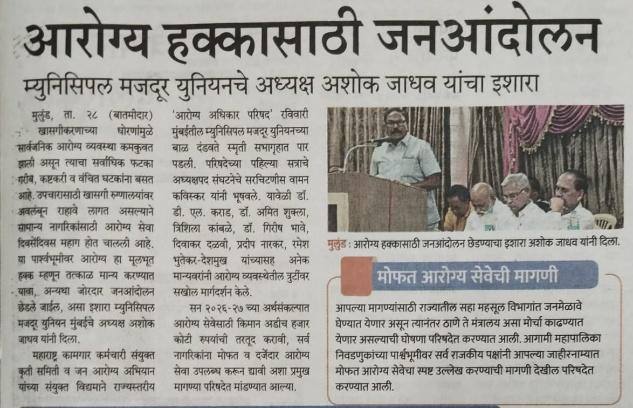
Health is our Right! Stop Privatisation, End Contractualisation!
- Deepak Jadhav and Abhay Shukla
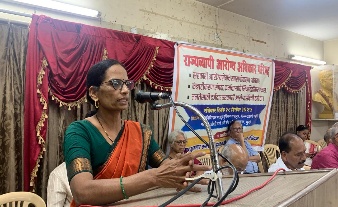
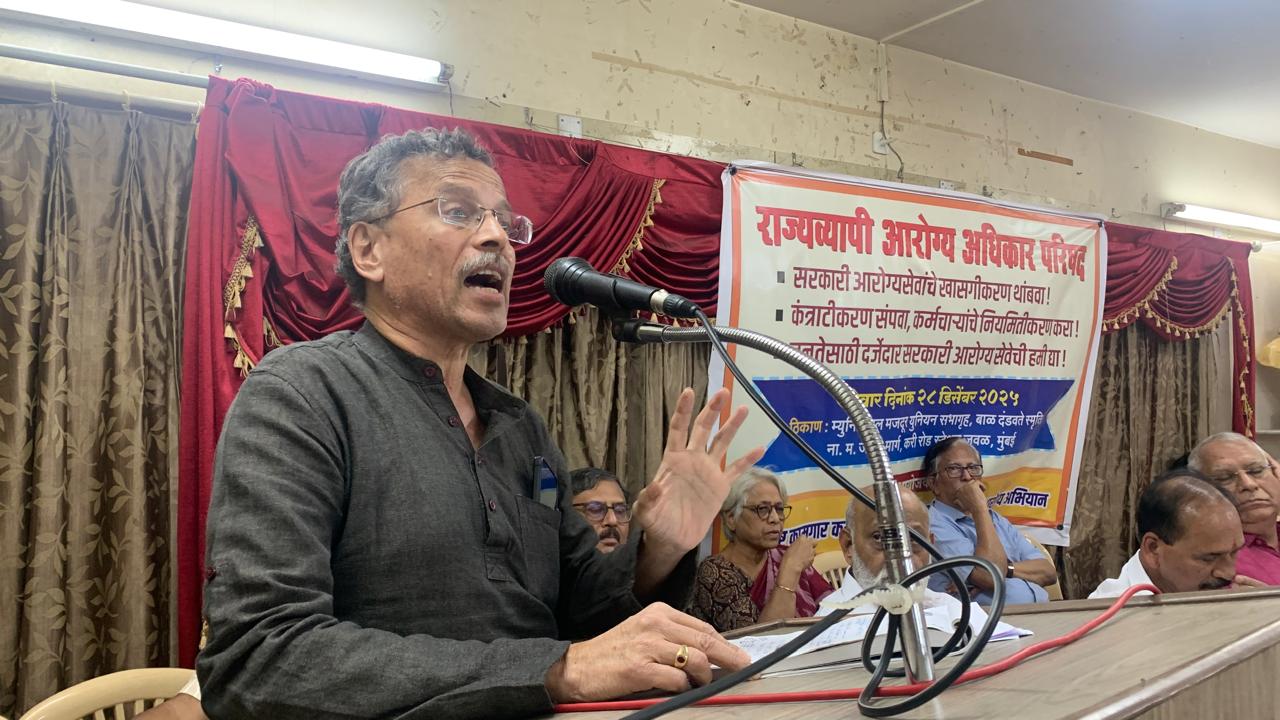
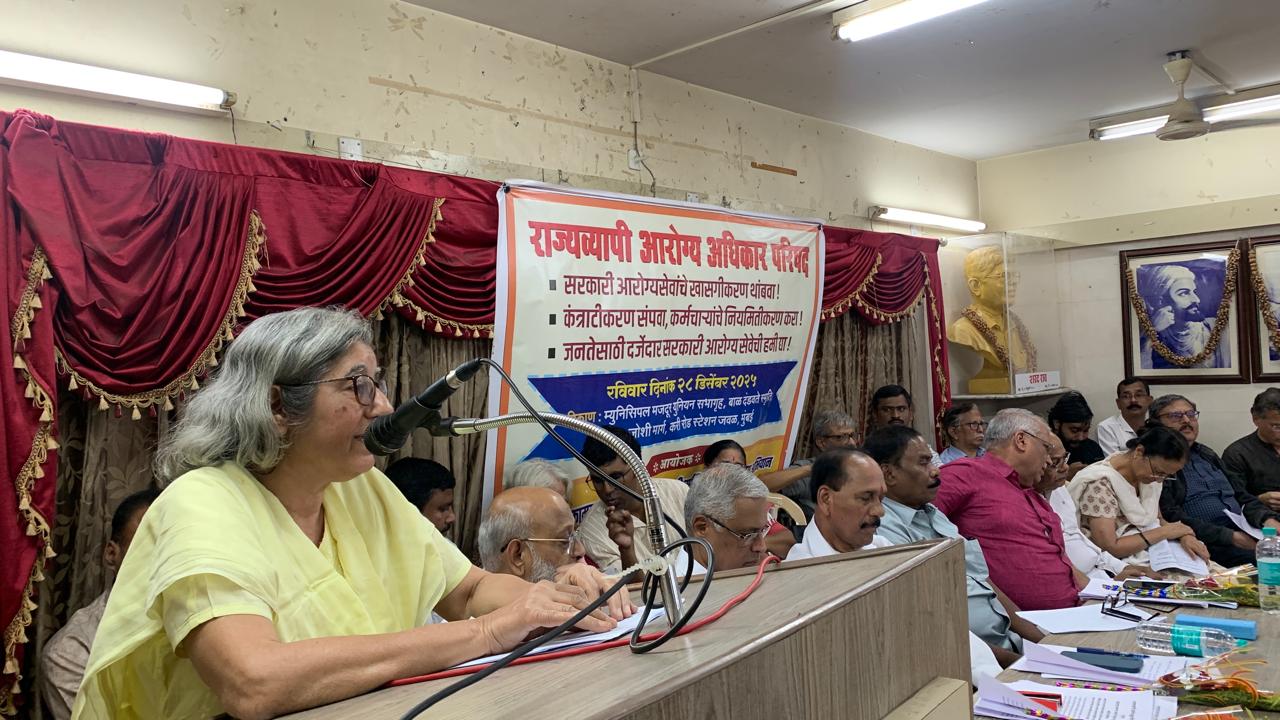
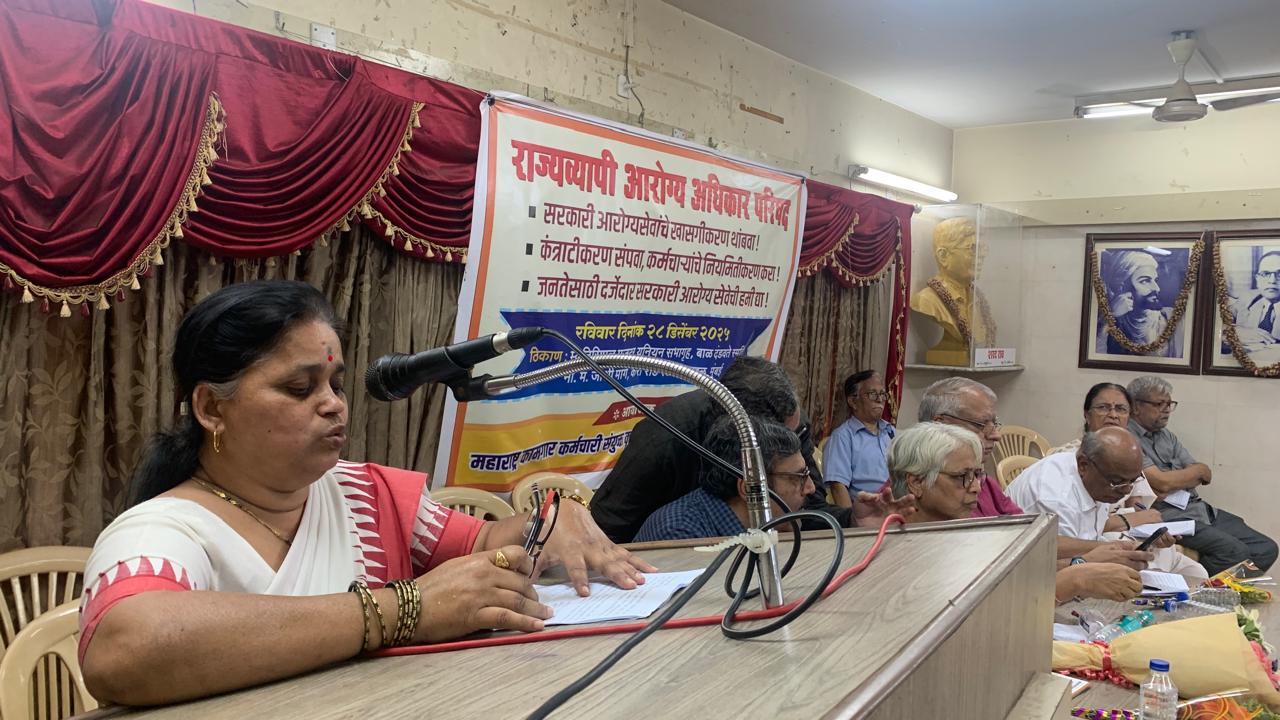
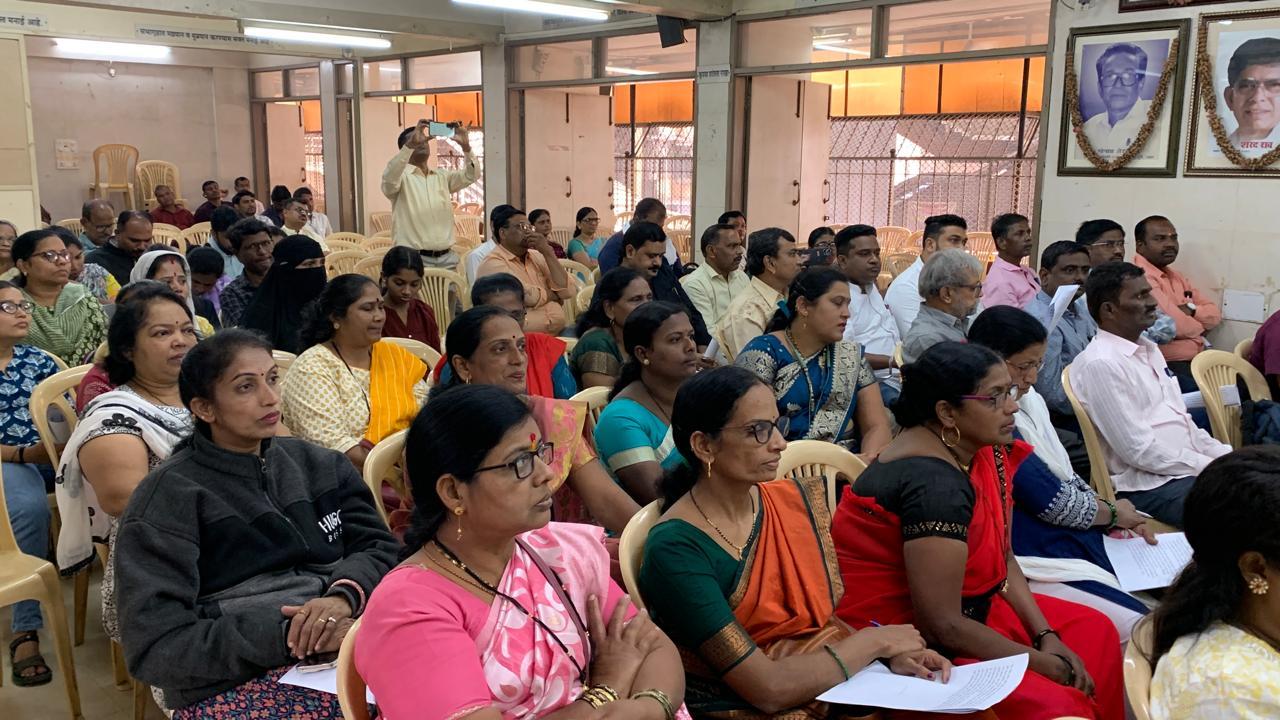
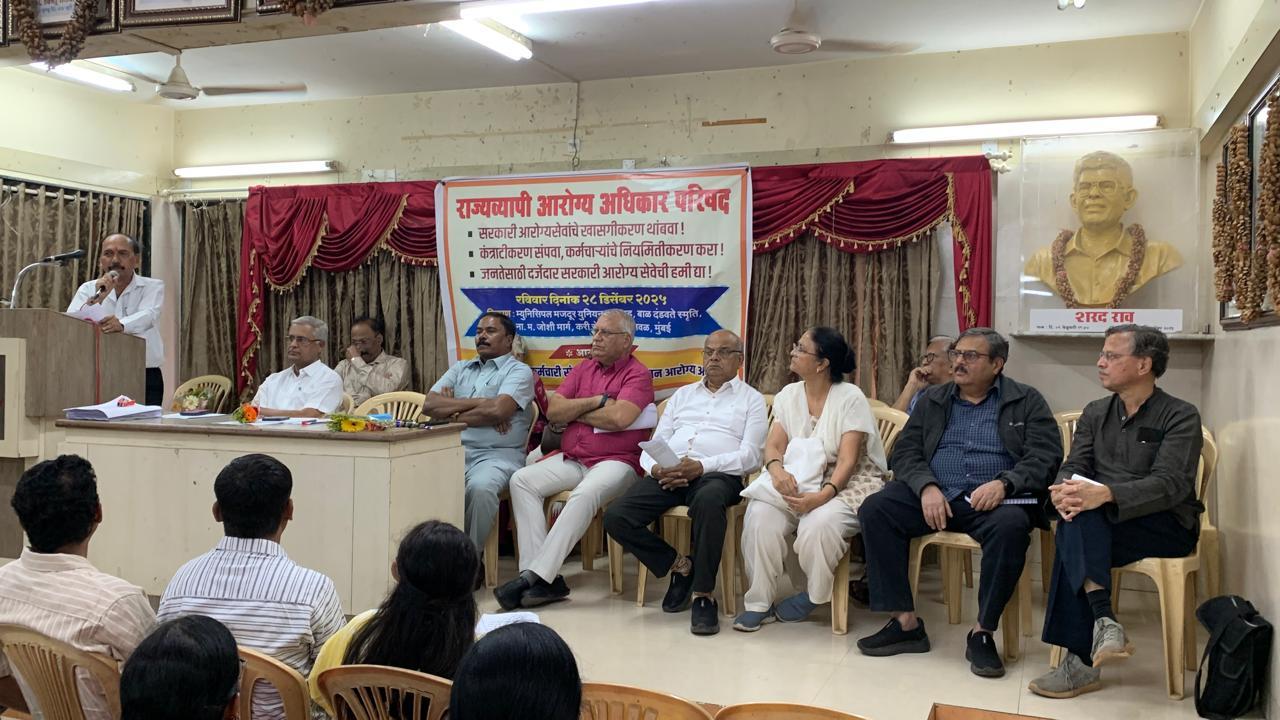
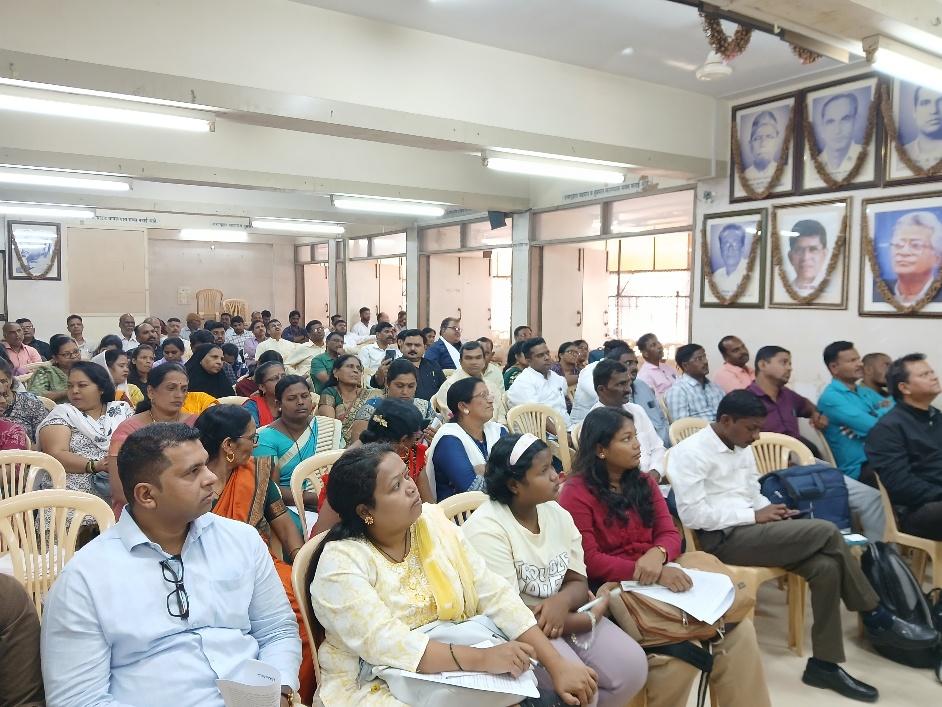
The state level Health Rights Convention held in Mumbai on 28 December 2025 at the Municipal Mazdoor Union hall brought together a wide range of health workers’ associations, trade unions, health activists, women’s organisations and social movements on a common platform. There was a clear, united assertion from over 150 participants coming from across ten districts of Maharashtra: healthcare is a fundamental right of people. The ongoing processes of privatisation of various public hospitals and health services being pushed by the State government, as well as Mumbai and other municipal corporations, must be stopped immediately. This should be accompanied by ensuring major strengthening of public health services, along with ensuring justice to health workers, through regularisation of contractual and scheme based staff.

Organised jointly by the Maharashtra Trade Union Joint Action Committee and Jan Arogya Abhiyan (JSA-Maharashtra), the convention strongly reflected the growing and significant unity between the labour movement and the health movement in Maharashtra. The active role played by leading trade union activists from various federations including CITU, AITUC, HMS, AICCTU and INTUC in organising the convention was notable. In the inaugural session, Ashok Jadhav and Trishila Kamble, leaders of Municipal Mazdoor Union, the largest trade union of Mumbai Municipal Corporation workers including nurses and hospital employees, emphasised that ongoing policies of privatisation, public–private partnerships (PPP), outsourcing, and contractualisation are directly harming both ordinary citizens and health workers. This calls for launching a massive joint struggle on health rights, where trade unions will play a major role.
Health Rights Charter – Demanding Change in Health Policies
The Health Rights Charter for the convention was presented by Dr D. L. Karad (Convenor, Maharashtra Trade Union Joint Action Committee and National Vice-president, CITU). The Charter clearly states that the public healthcare system is being deliberately weakened to pave the way for privatisation and corporate takeover. Government funds are being diverted towards private corporations, while public hospitals and health centres are being hollowed out. The Rs. 10,000 crores contract for outsourcing of ambulance services in Maharashtra being rolled out from mid-2025, is a prime example of massively wasteful and harmful privatisation of health services, which is damaging for both people and health employees. Based on the Charter, one of the key demands of the convention was the doubling of the state public health budget, and using this enhanced allocation to strengthen primary health centres, public hospitals, and medicine supply systems across both rural and urban areas.
A strong demand was raised to immediately halt all forms of privatisation, PPPs, and outsourcing in the health sector. Alongside this, the convention placed the issues of health workers at the centre of struggles. There was consensus on demands to abolish contractualisation, implement equal pay for equal work, urgently fill all vacant posts, regularise contractual workers including NHM contract workers, ASHAs and Anganwadi workers, while creating a separate cadre for Community Health Officers, and integrating sanitation workers and support staff into the regular health services. The convention also demanded state level health humanpower guidelines, including transparent transfer and promotion processes, the implementation of structured career progression plans for health workers, along with eradication of corruption in appointments and transfers etc.
Special emphasis was placed on the expansion and strengthening of ESI hospitals and dispensaries, which are key for health and social security of the working class. Key demands include major upgradation of ESI health services, simplifying access to ESI enrolment and treatment, providing ESI coverage to all health workers, activation of ESI related participatory committees at various levels to ensure accountability to workers, and including large numbers of contractual and unorganised sector workers within the ESI framework.
The convention strongly criticised the burden of unnecessary paperwork and growing pressure of burdensome data entry to be performed by health workers, while forcing them to collect irrelevant information, and to conduct questionable surveys which distract them from patient care and community health activities. To address chronic shortages of medicines, the convention demanded overhaul of the drug procurement and distribution system, drawing on effective models from states such as Tamil Nadu and Rajasthan.
The Charter clearly asserts that simply agitating for limited demands is not enough – that unless the current policy framework affecting people as well as health workers is dismantled, neither the people can secure their right to quality healthcare, nor can health workers obtain justice.
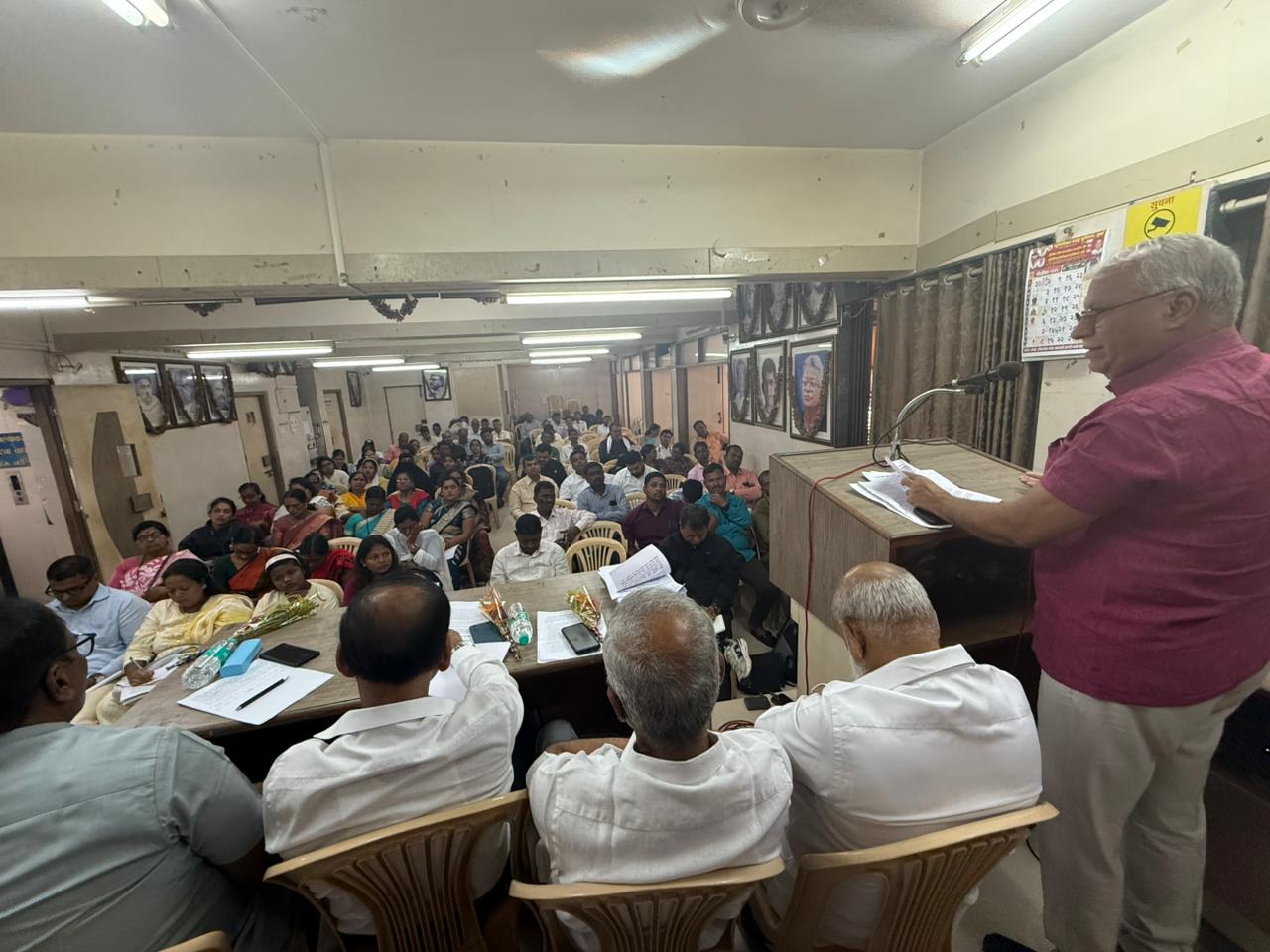
Following this, the discussion session featured interventions by senior trade union leaders Ashok Jadhav, Uday Bhatt, Shankar Pujari, Vaman Kaviskar, Pradeep Narkar, Anandi Avghade and others, along with health activists associated with Jan Arogya Abhiyan like Girish Bhave, Shubham Kothari, Ravi Desai among others. Women’s rights activists like Armaity Irani (AIDWA) spoke, and senior health activists like Dr Kamaxi Bhate and Avinash Kadam actively contributed to the convention. Union leaders representing ASHAs, 108 ambulance drivers, ambulance doctors, municipal nurses and hospital staff, and contractual health workers shared their striking first-hand experiences of staff shortages, excessive workloads, inadequate wages, collapsing infrastructure and damaging impacts of contractualisation. The session was moderated by Dr Dnyaneshwar Mote, Trishila Kamble, and Deepak Jadhav.
Action Programme: A Roadmap for Joint Struggle
Following presentation of the proposed joint action programme by Dr Abhay Shukla (Jan Arogya Abhiyan), the convention endorsed a set of action points to be carried out by health sector unions and health rights activists together:
- Taking the Health Rights Charter to ordinary people and health workers across the state through joint meetings, public outreach activities and social media posts to be organised on a wide scale.
- Across various talukas and cities in the state, fact finding related to government hospitals, health centres, and ESI services will be conducted, and short fact-finding reports will be prepared. Based on these reports, struggles and participatory monitoring efforts will be undertaken at the local level to improve public health services.
- Strengthening, supporting and expanding ongoing movements against privatisation of public hospitals wherever they are underway.
- In the context of the upcoming municipal corporation elections, the convention took a decision to dialogue with candidates and political parties, efforts will be made to compel them to take a clear stand in favour of major improvements in public healthcare while strongly opposing privatisation.
- At the state level, the convention expressed a firm resolve to build a broad-based mass movement. Once appropriate preparations have been carried out, it is proposed to organise a State level “Health Rights Long March” as a crucial next step for the struggle.
This state level convention has been distinctive for the socio-political convergence it has initiated. For probably the first time, health sector unions across multiple cadres—ASHAs, ambulance workers, nurses, municipal hospital staff, contractual health workers—strongly came together with health rights activists and public health movements on a shared platform. Backed by support from a spectrum of major trade union federations and the main state level trade union coalition, the convention has forged a common Health Rights Charter and action programme that consciously integrates the rights of the people to quality public healthcare, with the rights of health workers to secure, dignified employment. By focussing on the jointstruggle againstprivatisation and contractualisation, this convention has the potential to initiate a unified statewide movement to take forward the health movement in Maharashtra, keeping people and health workers at the centre.